C. S. Lewis’s family move to the New House
Surprised by JoyIn 1905, when C. S. Lewis was seven, his family moved from the semidetached villa where he had been born to a much larger house farther out into what was then the country. The New House enlarged the world of his childhood: its long corridors, quiet rooms, explored attics, and inexhaustible books became the setting for a growing life of solitude and imagination, while its outlook over Belfast Lough gave the home a distinctive landscape that endured in memory.
The Move and the New House
Lewis’s father, growing more prosperous, decided to leave the family’s old home and build a larger one. The builders cheated him: the drains and chimneys were wrong, and drafts ran through every room. Those failings mattered little to a child. Lewis remembered instead the house’s extraordinary scale, which made it seem less like a home than a city. He later called the New House almost a major character in his story, a measure of how deeply its rooms and atmosphere entered his sense of his own past.
The house’s formative character lay in its spaces and sounds. Lewis associated his childhood there with long corridors, empty rooms lit by the sun, indoor silences upstairs, solitary explorations of the attics, and distant gurgling from cisterns and pipes. Wind under the tiles joined those sounds. These were not merely architectural details: together they describe a home that offered a child both a vast territory to explore and plentiful places to withdraw into solitude.
Books, Solitude, and Childhood
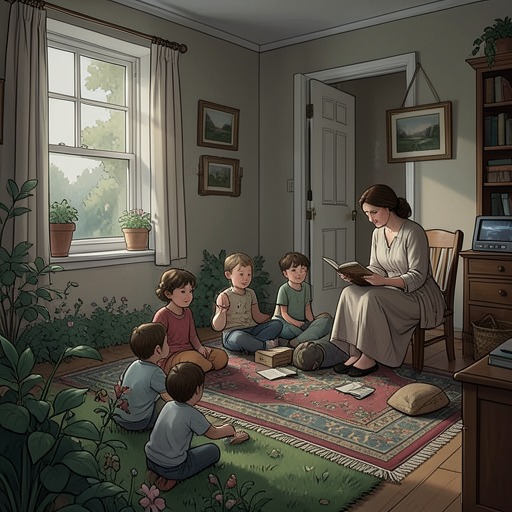
Books filled the New House. Lewis’s father kept every volume he bought, so books accumulated in the study, drawing room, cloakroom, bedroom, and landing bookcase, as well as in the cistern attic, where they rose as high as Lewis’s shoulder. They reflected the changing interests of his parents and included books suitable for children alongside others emphatically not intended for them. Nothing was forbidden to him. On rainy afternoons he could take volume after volume from the shelves, with the same certainty of finding something new as a person walking into a field and finding a new blade of grass.
The abundance of books belonged to a wider pattern of independent occupation. Lewis had learned to read and write and had a dozen things to do; solitude was almost always available somewhere in the house or garden. His recollection makes the move consequential less through a single dramatic disruption than through the new conditions it created: space to wander, quiet in which to be alone, and reading without a barrier between childhood curiosity and the family library.
The View and the World Beyond
From the front door, the family looked across broad fields toward Belfast Lough and the long line of the Antrim shore, including Divis, Colin, and Cave Hill. The Lough was then crowded with shipping, a spectacle that delighted both boys, especially Lewis’s brother. At night, the sound of a steamer’s horn could summon Lewis’s whole boyhood. The distant ships and their sounds made the view part of the family’s everyday imaginative world, not simply scenery beyond the house.
The prospect also gave the childhood landscape its changing emphasis. Behind the house lay the nearer, lower, greener Holywood Hills, but Lewis said they did not command his attention until much later. At first it was the northwestern view that mattered: summer sunsets behind blue ridges and rooks flying home. In later recollection, he also describes the Belfast below the hills through the throbbing and clattering of its shipyards and streets, a contrast that could intensify the peace of the heights. The New House thus stands at the meeting point of private childhood and a wider landscape of fields, water, mountains, shipping, and city noise.
Retrospective Significance
Lewis’s account presents the move as the first great change of his seventh year, but its significance unfolds through the environment that followed it. The larger house became a world in its own right, and its books and secluded spaces supported a childhood increasingly organized around reading and solitude. The view over Belfast Lough supplied another enduring element: shipping, mountain ridges, sunsets, and the nighttime horn remained bound to his memory of boyhood.
The memoir’s later descriptions of home life and landscape return to contrasts between inward and outward experience, quiet and activity, and remembered places and the meanings they acquire over time. The move therefore marks more than a change of address. It establishes the physical setting Lewis regarded as formative and the domestic conditions through which his childhood world expanded.